

Picture an elaborate fabric woven with golden and crimson threads, where rhythm meets melody, interwoven with the fragrance of jasmine. This is the world of an Indian wedding: a perfect convergence of tradition and lavishness. At the very centre of this grand and flamboyant affair is the groom’s procession—a dazzling affair heralding the coming together of two souls.
Let us undertake this journey into the varied and beautiful world of the Indian groom’s processions—from the magnificence of the Baraat to the spirited fervour of the Dol Baraat. It’s an endeavour on our part to understand the diverse ways in which India welcomes her grooms.
The Baraat: A Royal Spectacle
The Baraat is perhaps the most iconic of all Indian groom processions, primarily prevalent in North Indian Weddings. A cavalcade of colour, sound, and joy, a visual and acoustic feast that sums up the essence of Indian weddings—traditionally, with the groom arriving on horseback as a symbol of valour and masculinity. Recent times, though, have seen cars and even elephants making their grand entries.

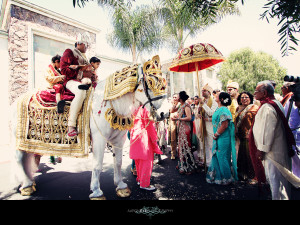
Image Source: http://www.larockphotography.com
The music is a multitude of Bollywood and folk songs as the Baraat meanders the streets; from the throbbing pulse of the procession offered up by the dhol, a traditional Indian drum, to the light-hearted tunes of the band, the whole atmosphere pulsates with unbridled enthusiasm. With the groom right in the center resplendent in wedding attire, accompanied by his closest friends and family, who dance and sing with abandon, a joyful procession ensues.
The arrival of the Baraat at the wedding venue is a grand occurrence. Warm hospitality is extended to the groom by the bride’s family, and the exchange of garlands or Jai Mala signals the formal start of the marriage ceremony.
The Dol Baraat
If the Baraat is a spectacle and royal, the Dol Baaraat is a riot of colour and exuberance. It is a typical procession in some parts of India that takes place during Holi, with the veritable celebration of joy and rejuvenation.
Here, amidst a shower of coloured water and dry powder, comes the groom – where colours have been sprayed all over to make it fun-filled, playfully resonating with the spirit of Holi. The procession is filled with music, dance, and laughter as guests revel in the festive atmosphere. The Dol Baraat is the celebration of life, love, and the harmonious blending of two families.
Other Notable Groom Processions
Although the best-known are the Baraat and Dol Baraat, India is rich in other traditions of the groom’s procession. In some regions, the groom is carried on his friend and family’s shoulders on a palanquin. Apart from that, in some regions, the groom makes a grand entry on a chariot that symbolises victory over adversity.
Whether it is a mare or a horse or, for that matter, even a car, the groom’s procession is one happy ride characterised by music, dance, and a fountain of blessings. It is absolute merriment where the beginning of a new life is promised to be the personification of happiness.
A Closer View of the Baraat: The Groom’s Equine Envoy
Let us step into the heart of the Baraat—a procession that is both symbolic and perfect at the same time. The horse, with its beautiful finery, acts as a royal steed for the groom and takes him towards his destiny. The view is truly spellbinding.
The choice of a horse does not just happen by chance. In many cultures, the horse is regarded as a sign of strength, power, and nobility. It is considered that the mere choice of a horse will bring good luck for the couple to enjoy prosperity and harmony in their marital life. To that effect, the groom proudly sitting on his equine companion symbolises the valiant prince who is ready to claim his bride.
More than the horse, the Baraat is a treat to the senses: the rhythmic thrum of the dhol, mingled with the clash of cymbals and the melodic tunes of the band, blend into a hypnotic soundscape that propels the procession along. The air is filled with heavy fragrances from jasmine and marigold, as bright and colourful wedding attire and decorations evoke a feeling of great opulence.
Not just a procession, it seems more of a performance art, a spectacle that unravels before all captivated eyes. In their best attires, the groomsmen are seen dancing with great ease, and their energy is infectious. The baraat people turn out to be a reflection of Indian society, with a mix of cultures and traditions coming to celebrate love from all walks of life.
The Baraat– A contemporary, living tradition which changes with every passing moment but stays deeply rooted in the extensive heritage of the holy nation. In times where the modern world has led to a revolution in the celebration of weddings, the core nature of the Baraat has not changed a bit. It is a timeless ritual, a celebration of love and happiness, a manifest of the enduring spirit of India.
The Royal Rajasthani Baraat
Now, let us look at the royal state of Rajasthan, where wedding celebrations attain surreal proportions. Rajasthani Baraat is a mesmerising manifestation of the grandeur and regality that this desert kingdom exudes.
Picture a procession colourfully decked out in red, gold, and green. The groom, resembling a prince in every detail, sits atop a lavishly decorated elephant—an animal that can command people’s attention due to its majestic size alone. It’s hard not to have your eyes drawn to the gorgeous adornment, somewhat resembling jewellery draped over an elephant heading rhythmically to mesmerise onlookers.
A great story of sound is aroused by the artists dressed in brilliant turbans and sweeping flowing robes, each with his traditional instrument in hand, creating a harmony of musical sound. The thudding rhythm of the dhol is expertly embossed with ethereal melodies from the shehnai, driving the listener deep into a world of enchantment.

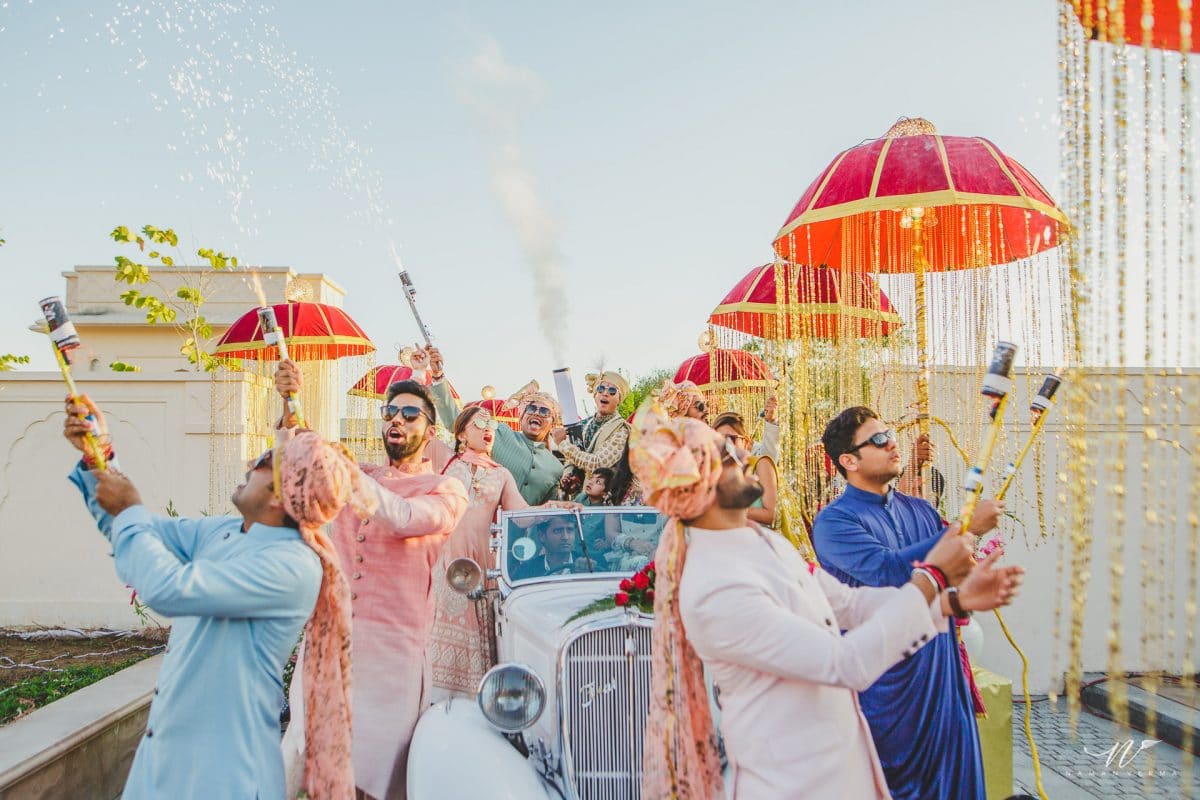
Image Source: https://www.vogue.in/content/a-royal-wedding-across-rohet-and-alwar-in-rajasthan
The Rajasthani Baraat is no less than a processional; it is a live canvas of this rich cultural heritage manifested in myriad hues. With intricate patterns of mehndi on their bodies, folk dancers’ gestures are fluent and reflect the rhythm of the music. The whole procession has the appearance of a spectrum of colours, sounds, and movements, probably one of the most visually striking feasts one can go through.
As the Baraat meanders its way through thronging streets, it is cheered and applauded by all who stop to watch. Children gazing wide-eyed gape at the splendid sight of the processional while elders bless the couple with heartfelt prayers. Not just the arrival of the groom, the Rajasthani Baraat celebrates collective and community joy.
The Kerala Wedding Procession
As we shift to the magical land of Kerala, where nature and culture combine to make the experience nothing short of divine, a different type of wedding celebration unfolds. A Kerala wedding procession is a pacifist, quiet sort of celebration that hardly contrasts with the huge wedding processions of the north but is no less exciting.
The procession, while replete with loud colours and boisterous excitement, bears simplicity and grace, which is the hallmark of a Kerala wedding. The groom, usually dressed in a traditional Kerala mundu and shirt, is brought to the venue by just a few close friends and relatives. There is absolutely no fanfare, as may be witnessed in other places, but only quiet, bearing no ostentation whatsoever.

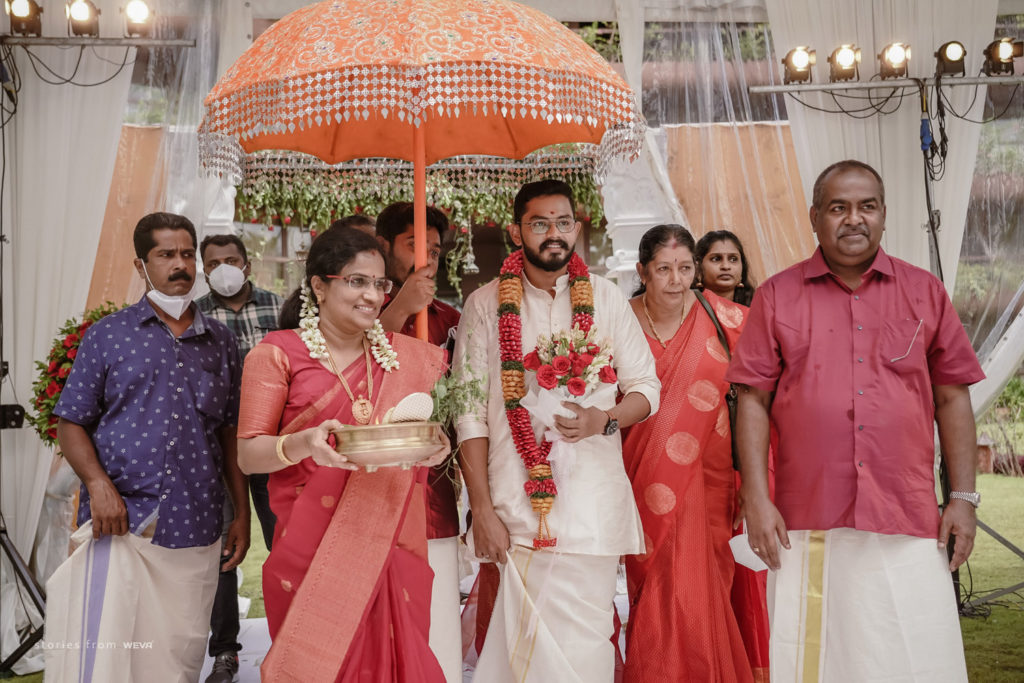
Image Source: https://wevaphotography.com/kerala-traditional-hindu-weddings-vineesh-greeshma/
Music is the very pulse of the procession, but it melodiously and softly flows instead. It is really comforting, with the enchanting tunes of the flute and the gentle rhythm of the chenda—a type of percussion instrument. The procession is often led by traditional Kerala dance forms, exquisitely leaning into the occasion, known as Kathakali.
The Kerala wedding symbolises the backwaters and the laid-back swings of life that the state represents. It’s an intimate and graceful celebration of love and family. It might not be as ostentatious as in some other parts of the country, but here, the charm is heartfelt.
The Vibrant Tamil Nadu Wedding Procession
Let us now move to the southern state of Tamil Nadu, where tradition and modernity are so artfully interwoven. The wedding procession is very much part of Tamil Nadu in south India. It might share a name with a similar one in North India (baraat), but it has its own character.
The groom, dressed in a pristine silk dhoti and shirt as usual, arrives in a procession to the wedding venue. Bands play with trumpets, ushering in all the zeal in the air. The Tamil groom generally comes in a car at the wedding venue; however, it is not strange to see grooms coming on horseback or even elephants, especially in the rural regions.

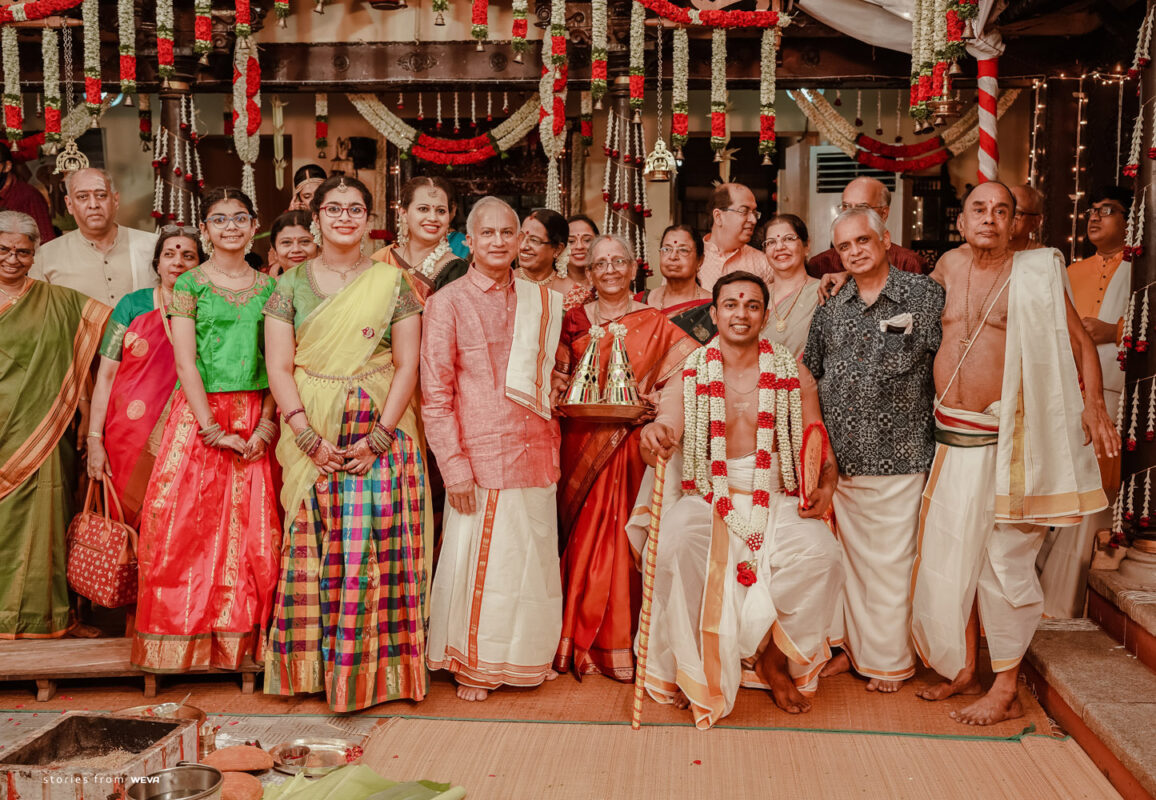
Image Source:
Rhythm is what the entire procession carries. The traditional Tamil folk dances—Karagattam, Oyilattam—enacted as a part of the bridegroom’s procession, bring an element of cultural richness to the occasion. The colourful costumes of the dancers and the rhythmic beats of the drums present excellent visuals and an audio treat.
The procession of Tamil Nadu is excitement and cheer, life, love, and togetherness.
The ‘Bor Jatri’ of Bengal
Now, let us come to the eastern state of West Bengal, where life’s rhythm is slow and serene. The Bengali wedding procession, or ‘Bor Jatri,’ beautifully reflects the majesty of simplicity.
Unlike the processions in other wedding cultures, the Bengali wedding procession is smaller and more intimate. The bridegroom, usually dresses dashingly in a dhoti-kurta or sometimes a sherwani, reaches the wedding venue in the company of a very few close friends and relatives. The concept is simplicity with stress on traditionalism.
Music that is inseparable yet indistinct and euphonic. Enchanting flute tunes and soft beats of the dhol combine to create serenity. It is also often interspersed with indigenous Bengali dance forms like Rabindra Nritya, that add a touch of cultural grace to the procession.
The Bengali wedding procession is, in essence, a fable of love and family exuded through warmth and hospitality. It is an affair of serenity and understatement in harmony with the spirit of Bengal.

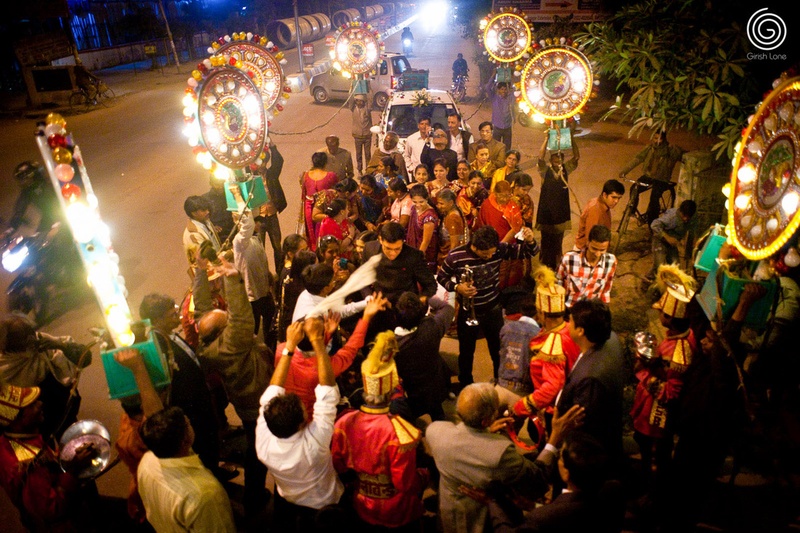
Image Source: https://m.weddingz.in/blog/bengali-wedding-rituals/
Travelling through the topography of these different Indian groom processions is an in-depth appreciation of the richness and complexity of the cultural fabric. Their colours transport from the regal grandeur of a Rajasthani Baraat to the serene elegance of a Bengali Baari in myriad processions, each uniquely an expression of its region’s soul.
More than an event of formality, a bridegroom’s procession is a living tradition that binds generations together. It is the celebration of love, joy, and community: an Indian wedding is incomplete without the elan and the boisterous energy of Tamil Nadu, the royal touch of Rajasthan, or the gentler rhythms of Kerala—each leaves its indelible mark on the hearts of the onlookers.
So, as we end this exploration here, we take back with us the memories of these enchanting processions that are a reminder of the beauty and diversity so characteristic of our India.